For years, topical authority has been the gold standard for crafting content that ranks well in search. But as AI-driven search evolves, this framework is showing its limits—it only tells you how to build content, not how to make sure AI picks your content over the competition. To win in AI search, you need a more comprehensive approach: the 3x3 Topic Ownership Model.
Topical Authority’s Blind Spot in AI Search
Traditional topical authority focuses on three pillars: semantics, content depth, and structural organization. These are critical for building high-quality content, but they don’t address the core of AI search: a competitive selection process where AI sifts through hundreds of candidate pieces to pick the best fit. Topical authority describes what you’ve built, not why AI will choose your work over others. That’s where topic ownership comes in—it’s the metric that determines whether your content makes the final cut.
The 3x3 Topic Ownership Model: Your Blueprint for AI Search Success
This model breaks down topic ownership into three interconnected rows, each with three key components, creating a 9-cell framework that covers every aspect of AI content selection:
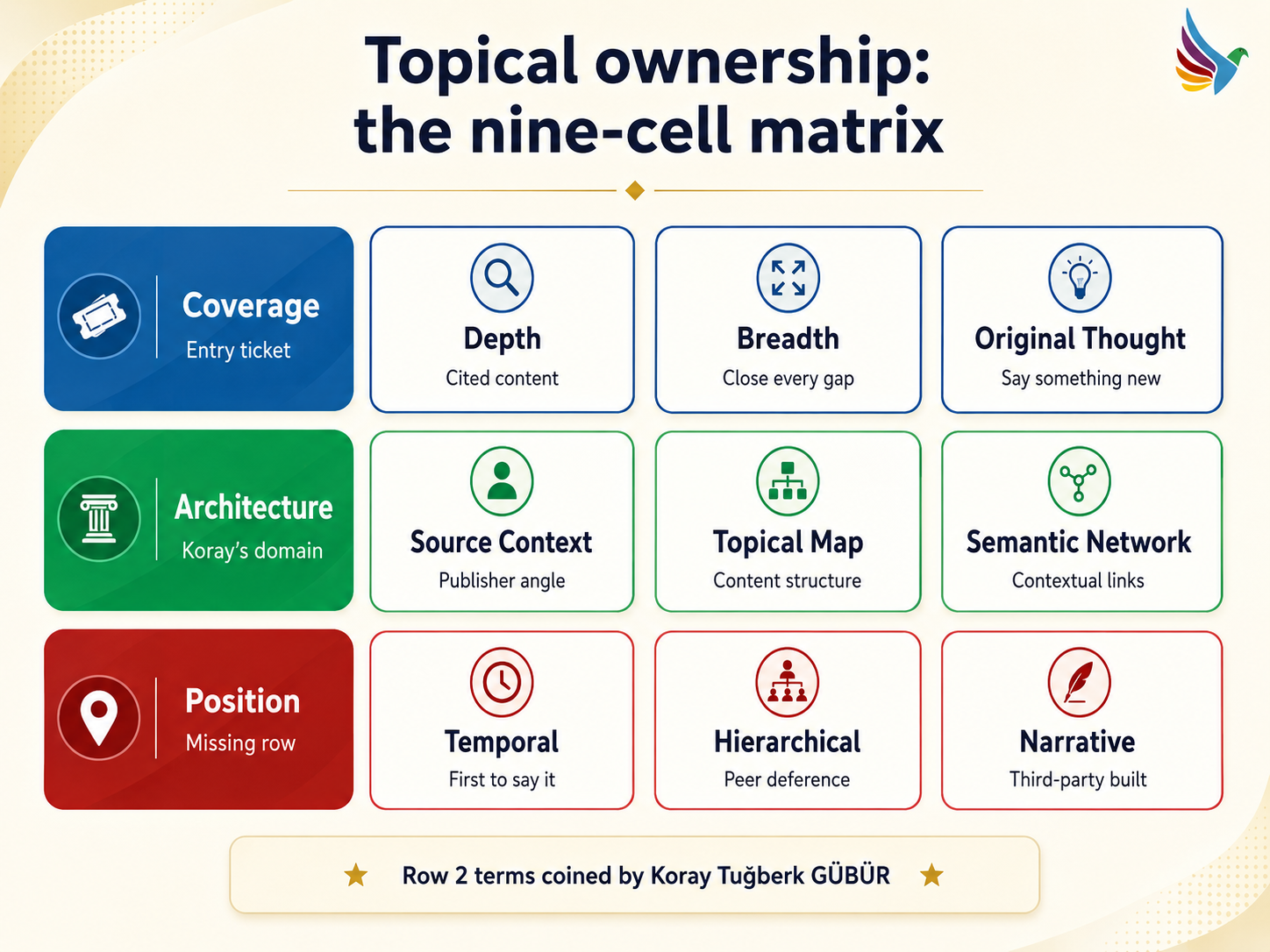
Coverage is your ticket to the candidate pool: without it, your content won’t even be considered. But just checking off depth and breadth isn’t enough—original thought ensures your content stays relevant, as generic comprehensive content gets absorbed into AI training data over time.
Architecture is the bridge between your content and AI. Even the best content is useless if AI can’t parse it. A strong architecture, built around topic maps, semantic networks, and your publisher identity, ensures AI understands your work’s value.
Position is your competitive differentiator. This entity-focused dimension requires long-term investment, but it’s what sets your content apart from equally high-quality pieces. Temporal, hierarchical, and narrative positions signal to AI that your content is the most authoritative and relevant choice.
Aligning with N-E-E-A-T-T: Credibility Signals Reimagined
The expanded N-E-E-A-T-T framework (adding Notability and Transparency to E-E-A-T) provides critical entity credibility signals, but it’s not a standalone solution. Here’s how it maps to the Topic Ownership Model:
- Hierarchical Position aligns with Expertise and Authority
- Narrative Position maps to Notability
- Temporal Position and Original Thought fall outside N-E-E-A-T-T’s scope
Generic N-E-E-A-T-T optimization lacks context. To truly build credibility, you need to audit and optimize all nine cells of the Topic Ownership Model.
AI Search’s Gate6: Where Position Decides the Winner
AI search operates in stages, and the real competition starts at Gate6 (Recruitment). Gate5 (Annotation) is an absolute audit—your content either meets basic standards or it doesn’t. But Gate6 is where AI compares candidate content head-to-head:
- Coverage gets you into the candidate pool
- Architecture lets AI understand your content’s value
- Position determines whether you’re selected as the top result
Entity signals, which form the foundation of the Position row, are becoming increasingly critical. Investing in this dimension is non-negotiable for future-proofing your AI search strategy.
Building Full Topic Ownership: The 9-Cell Mandate
Right now, most brands only optimize six of the nine cells in the model—ignoring the Position row entirely. To achieve true topic ownership, you need to deliberately build every cell, mapping each optimization task to a specific dimension. This focused approach ensures your efforts directly contribute to AI search success.