Introduction
The life sciences industry has long grappled with lengthy drug development timelines and fragmented research workflows. OpenAI's latest release, GPT-Rosalind, aims to address these challenges with a purpose-built AI model tailored for biology, drug discovery, and translational medicine.
News Analysis
News Title: Introducing GPT‑Rosalind for life sciences research (April 16, 2026)
Importance Score: 8.5/10
News Summary: OpenAI launched GPT-Rosalind, a frontier reasoning AI model optimized for life sciences workflows, offering enhanced tool integration and domain expertise. It's available via a trusted access program for qualified customers, alongside a free Codex plugin connecting to 50+ scientific tools.
Key insights from the announcement:
- Specialized Capabilities for Scientific WorkflowsGPT-Rosalind is designed to handle complex tasks across chemistry, protein engineering, and genomics. Evaluations show it outperforms existing models on multi-step workflows like literature review, sequence interpretation, and experimental planning. Its ability to synthesize evidence and generate hypotheses aims to accelerate early-stage discovery, where gains compound downstream to improve drug development outcomes.
- Strong Industry Validation and PerformanceThe model has secured partnerships with leading life sciences organizations including Amgen, Moderna, and Thermo Fisher Scientific. Benchmark results highlight its leading performance: top scores on BixBench for bioinformatics tasks, outperforming GPT-5.4 on 6 of 11 LABBench2 tasks, and ranking above the 95th percentile of human experts on RNA sequence prediction tasks in collaboration with Dyno Therapeutics.
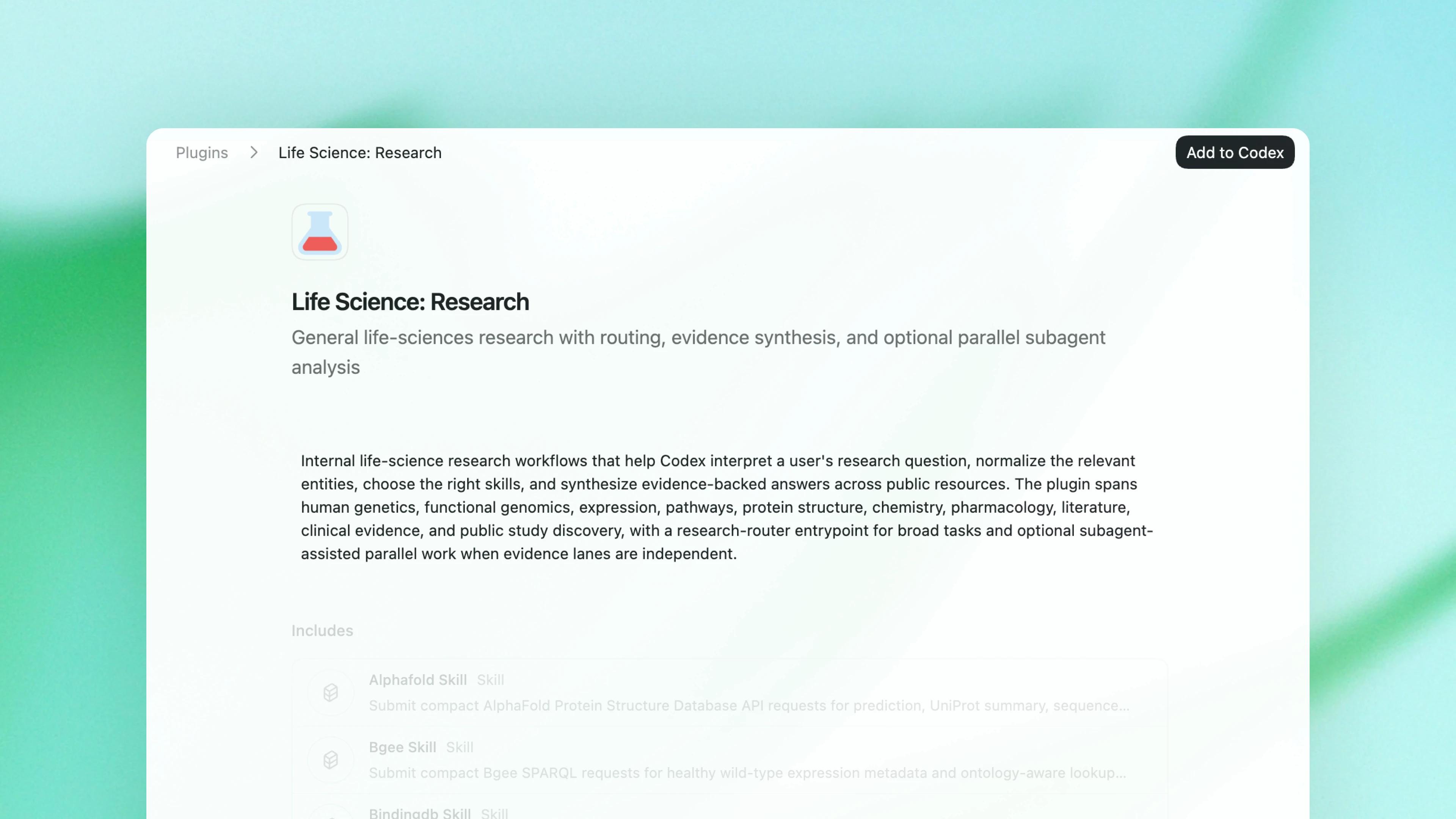
- Responsible Access FrameworkOpenAI is deploying GPT-Rosalind through a trusted access program for qualified U.S. enterprise customers, with strict eligibility criteria focused on beneficial use, governance, and security. A freely available Life Sciences Research Plugin for Codex is also accessible to all users, providing integration with over 50 scientific databases and tools to enhance research efficiency.
Conclusion & Commentary
GPT-Rosalind represents a significant advancement in AI-driven scientific research. By targeting the unique bottlenecks of life sciences workflows, it has the potential to reduce drug development timelines and unlock breakthroughs that might otherwise take years to achieve. The strong industry partnerships and impressive performance benchmarks underscore its credibility, while the responsible access framework addresses critical safety concerns.
As OpenAI continues to expand the model's capabilities, GPT-Rosalind could become an indispensable tool for researchers, transforming how scientific discoveries are made and bringing new treatments to patients faster. However, its long-term impact will depend on ongoing real-world testing, integration into existing enterprise systems, and continuous refinement of its biological reasoning abilities.