Ask an AI search tool like Google AI Overview or ChatGPT a question like “What’s the best facial cleanser for teen oily skin,” and it doesn’t just pull a single top-ranked link. Instead, it quietly splits your query into dozens of related sub-questions, scours the web for answers to each, and weaves those insights into a cohesive, contextual response. This behind-the-scenes process is called query fan-out—and it’s redefining how search works, and how you need to optimize your content for it.
What Is AI Search Query Fan-Out?
Query fan-out refers to the process where AI engines expand a single user query into multiple related sub-queries, gather multi-dimensional information from diverse sources, and synthesize it into a comprehensive answer. At its core, it’s about uncovering a user’s unspoken intent, drawing on the “fan out” metaphor of radiating from a central point to cover all relevant angles.
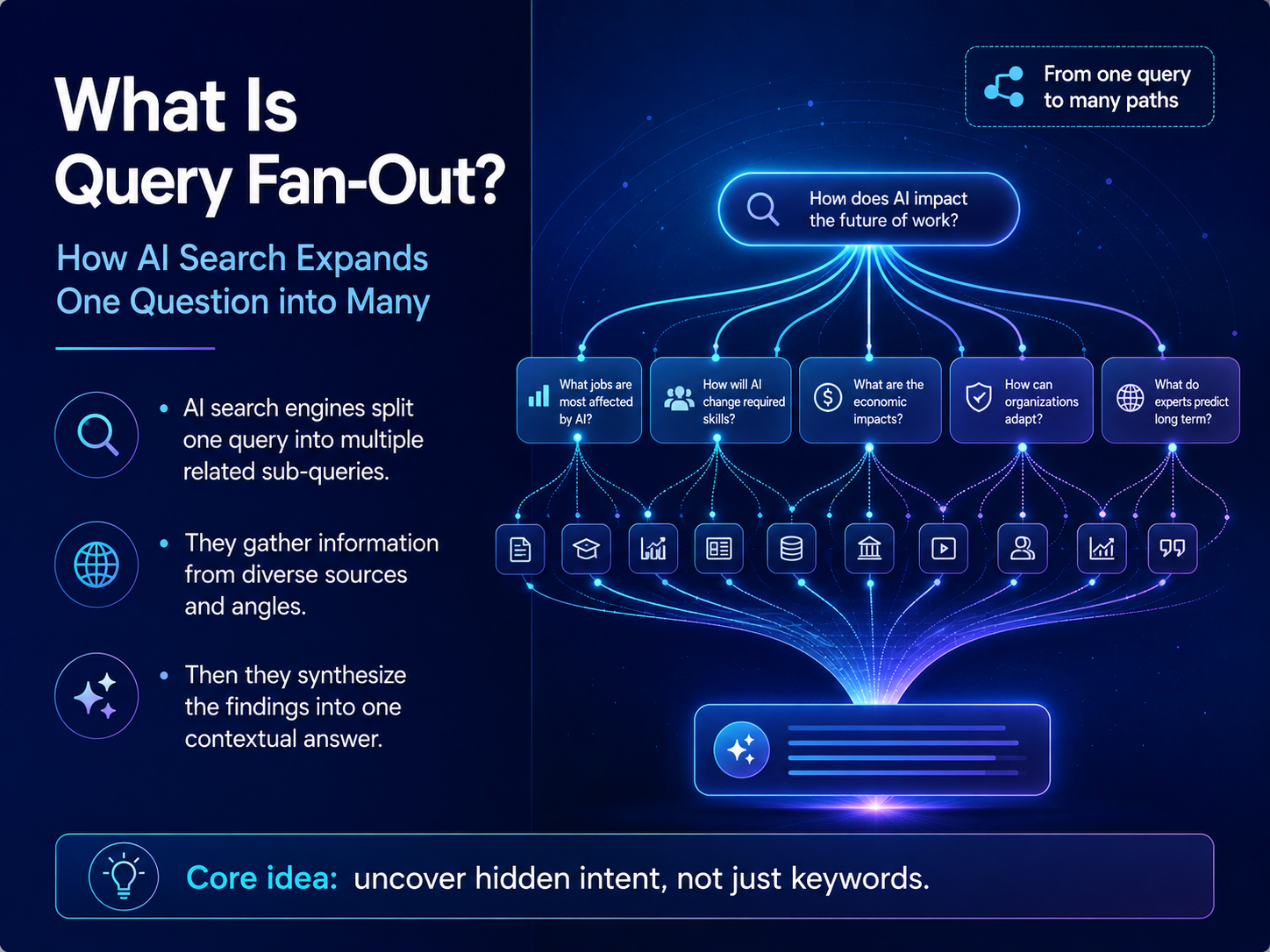
While “query fan-out” is the industry’s common shorthand, not all AI platforms use this exact term. Google’s patent US11663201B2 refers to it as “query variant generation,” describing a system that uses generative models to create multiple query variations, then merges results to form the final response. Other official terms include query decomposition, multi-query retrieval, query rewriting/expansion, iterative retrieval, and agent planning/tool calling.
Leading AI Tools Leveraging Query Fan-Out
Virtually every major AI search tool relies on query fan-out to deliver robust answers:
- Google AI Overview & AI Mode: Generates multi-dimensional sub-queries to pull from a wide range of linked resources across data sources.
- Gemini: Automatically generates one or more search queries when it needs external information to supplement its internal knowledge.
- ChatGPT: Rewrites queries and uses partner search providers to fetch data when questions fall outside its training cutoff or internal database.
- Grok: Uses restricted query fan-out, rephrasing prompts into multiple focused forms, running limited searches, and prioritizing reliability through source constraints and repeated validation.
- Perplexity: Previously showed users the step-by-step split of queries, but now runs the process entirely in the backend.
- Microsoft Copilot: Uses iterative query expansion with the Bing index (or internal enterprise data) where each search result guides the next round of sub-queries.
The 5-Step Query Fan-Out Workflow
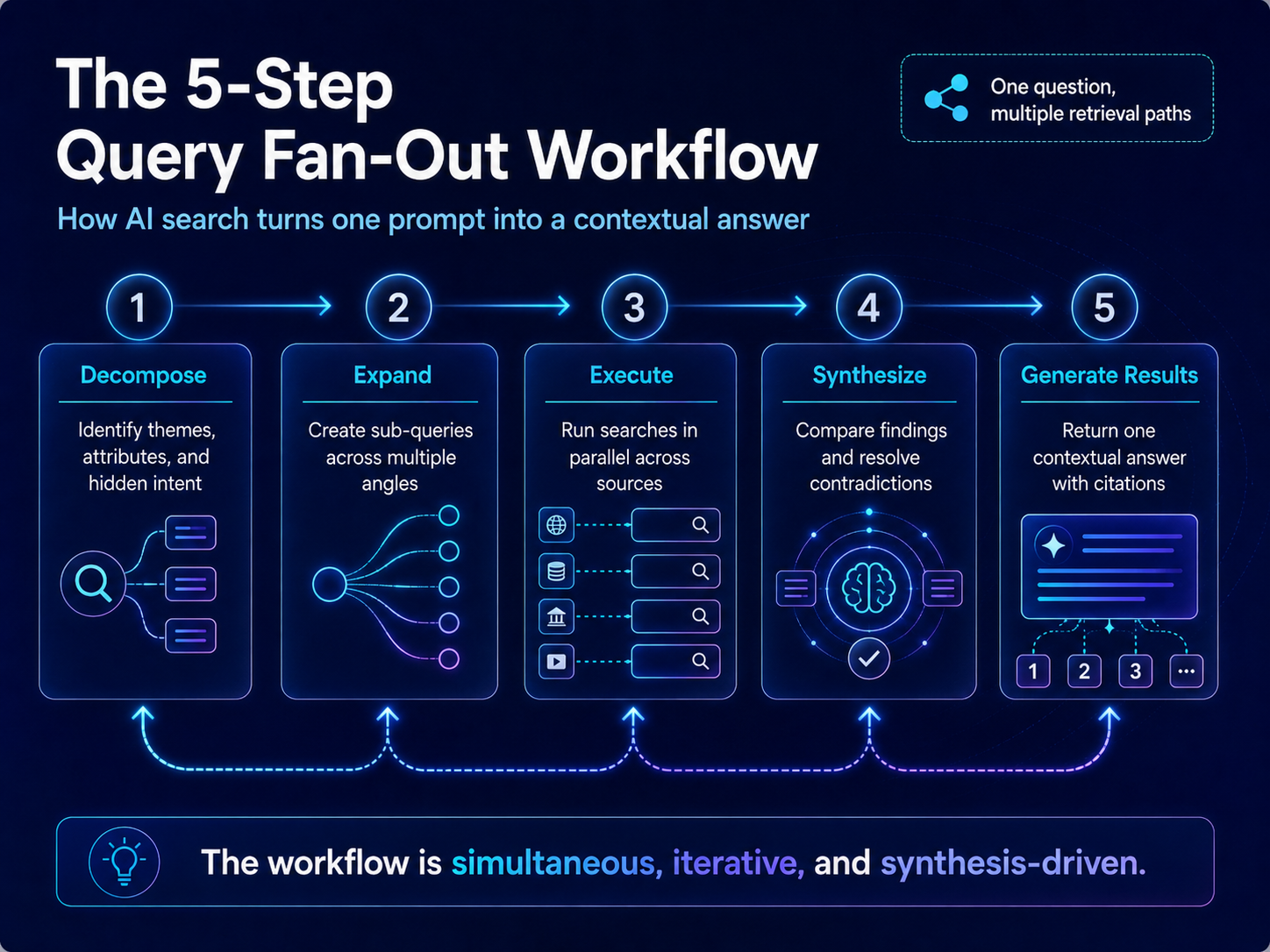
- Decompose: The AI analyzes the original query to identify core themes, attributes, and implicit questions, defining the full scope of information needed to answer thoroughly.
- Expand: It generates sub-queries targeting different dimensions of the user’s intent. For the teen oily skin cleanser example, this includes 8 types: equivalent, follow-up, generalized, specific, standardized, translated, implicit, and clarifying queries.
- Execute: Sub-queries run simultaneously across the web or specified data sources to avoid limited, one-sided results.
- Synthesize: A large language model organizes retrieved information, resolves contradictions, identifies common themes, and prioritizes relevance to structure coherent content.
- Generate Contextual Results: Instead of a list of links, the AI returns a synthesized explanation with cited source fragments.
Query Fan-Out vs. Traditional Keyword Research
Traditional keyword research centers on optimizing for individual search terms: pick a primary keyword, build a page around it, and refine metadata to rank. Query fan-out flips this model: it focuses on exploring and answering all related sub-questions tied to a single user query.
In AI search, systems evaluate whether content covers all relevant sub-questions of a topic, not just matches a single keyword. Topics that would have been split into separate pages in traditional SEO are now viewed as supporting sub-questions of one core theme.
How Query Fan-Out Transforms SEO Strategy
To succeed in AI-driven search, your SEO strategy must shift from single-keyword optimization to comprehensive topic coverage. Content that addresses all relevant sub-questions of a core query is far more likely to be cited by AI search systems. Conversely, narrow pages that only answer one specific, niche question have a much lower chance of being included in synthesized responses.
Evaluating Content Performance in AI Search
There’s often a gap between traditional search rankings and AI search performance: a page that ranks well in traditional results might not be used in AI-generated answers, and vice versa. To assess your content’s visibility in AI search, use tools like Semrush One to check how your content appears in AI overviews and get actionable optimization insights.
Query fan-out isn’t just a technical detail—it’s the backbone of modern AI search. By understanding how it works and adapting your content strategy to align with its priorities, you can ensure your content remains relevant and valuable in an increasingly AI-driven search landscape.